Public Summary of the Scientific & Technical Report of MEDYCONAI Grant Period 1 (1.01.2021-31.12.2021)
The MEDYCONAI project aims at developing a multimodal prototype nanoscope that offers easy operation and flexibility for imaging the structure and chemistry of samples in both 2D and 3D, named INTELINANO. A consistent part of the work carried out in Grant Period 1 was thus devoted to the development of two modules of this prototype, for near-field and far-field imaging, which together will incorporate complementary state-of-the-art and novel imaging techniques providing unprecedented possibilities for the label-based and label-free characterization of cells at nanoscale resolutions. In Work Package 1, the MEDYCONAI team has finalized the design of the near-field module of the INTELINANO platform and began its implementation. In Work Package 2, the design of the far-field module of the INTELINANO platform was finalized, and its implementation was initiated. In Work Package 3, the two teams focus on implementing a series of nanoscopy assays whose aim is to shed more light on important processes of cells involving membrane dynamics, with implications for the emergence of aneuploid cells, and the onset of carcinogenesis. In expectation of INTELINANO to be finalized, and its superb possibilities for correlative nanoscale imaging to be put to work, the two partners have employed in Grant Period 1 already existing state-of-the art sample preparation and imaging tools to address important problems aligned to the projects bioimaging themes. In Work Package 4, the two teams have commenced work aimed at developing artificial intelligence methods for (i) automated characterization of cells based on optical datasets collected at nanoscale and (ii) nanoscopy information forecast & data simulation. An important focus of attention has been placed on the design and acquisition of training data sets that support the development of the classification & data augmentation problems of interest, that have been defined by the two partners, UPB and OUH.
Public Summary of the Scientific & Technical Report of MEDYCONAI Grant Period 2 (1.01.2022-31.12.2022)
The MEDYCONAI project aims at developing a multimodal prototype nanoscope, INTELINANO, comprised of two modules for optical nanoscopy, operating in the far-field and near-field regimes, respectively. Based on the performance and complementarity of its workmodes, INTELINANO aims to provide unprecedented possibilities for the characterization of cells and advanced materials at nanoscale. After completing the design of the two modules in GP1, in GP2 the project team placed important efforts towards their implementation. In Work Package 1, the near-field module of the INTELINANO platform was implemented as a compact prototype and the consortium began optimizing its workmodes, and integrating it with an inverted microscope, which is required for the deployment of the far-field techniques. In Work Package 2, the consortium has advanced the implementation of the far-field module, also a compact unit, that can be attached to the lateral port of any inverted microscope. Some workmodes are still pending to be finalized. In Work Package 3, the two teams placed further focus of attention on implementing high-resolution imaging assays aimed at shedding light on important, but still poorly understood, processes of cells involving membrane dynamics, with deep implications for cancer understanding, prevention and therapy. To this end, the two partners have employed state-of-the art sample preparation and imaging tools to address various problems aligned to the projects bioimaging themes. In Work Package 4, the two teams have advanced their work focused on the development of artificial intelligence methods for (i) automated characterization of cells based on optical datasets collected at nanoscale and (ii) nanoscopy information forecast & data simulation. The overall efforts of this project supported so far the publication of 9 journal articles, 6 of these in journals with IF >10: PNAS, Small, Biomaterials, Acta Biomaterialia, Advanced Materials, Journal of Advanced Research.
Public Summary of the Scientific & Technical Report of MEDYCONAI Grant Period 2 (1.01.2023-31.12.2023)
The MEDYCONAI project is focused on creating a cutting-edge nanoscope named INTELINANO, which features two distinct modules designed for optical nanoscopy in both the far-field and near-field regimes. The goal of INTELINANO is to unlock new capabilities for analyzing cells and advanced materials at the nanoscale, leveraging the unique strengths and complementary functions of its operating modes. During the first phase, GP1, the design of these modules was completed. The second phase, GP2, saw significant progress in their development. The third phase, GP3 further advanced their implementation, closing in to the finalization of the prototype. In Work Package 1, the team completed the opto-mechatronic setup of the compact near-field module for the INTELINANO platform, and its integration with the AFM microscope and the inverted microscope required for far-field modalities. Work Package 2 involved further development of the compact far-field module, which can be attached to any inverted microscope’s lateral port. In Work Package 3, the focus shifted towards deploying high-resolution imaging assays to explore critical yet poorly understood cellular processes related to membrane dynamics, for example with fluorescence nanoscopy we analyzed and resolved important previously unknown aspects on the ultrastructure of KIF27 and its colocalization with other proteins that have been reported to have crucial functions in cytokinesis. Work Package 4 saw the teams push forward with the development of artificial intelligence tools for the automatic characterization of high-resolution images, for predicting nanoscopy information and simulating data. These collective efforts of GP3 have led to the publication of 9 articles, including in >10 IF journals such as Nano Today or Laser & Photonic Reviews.
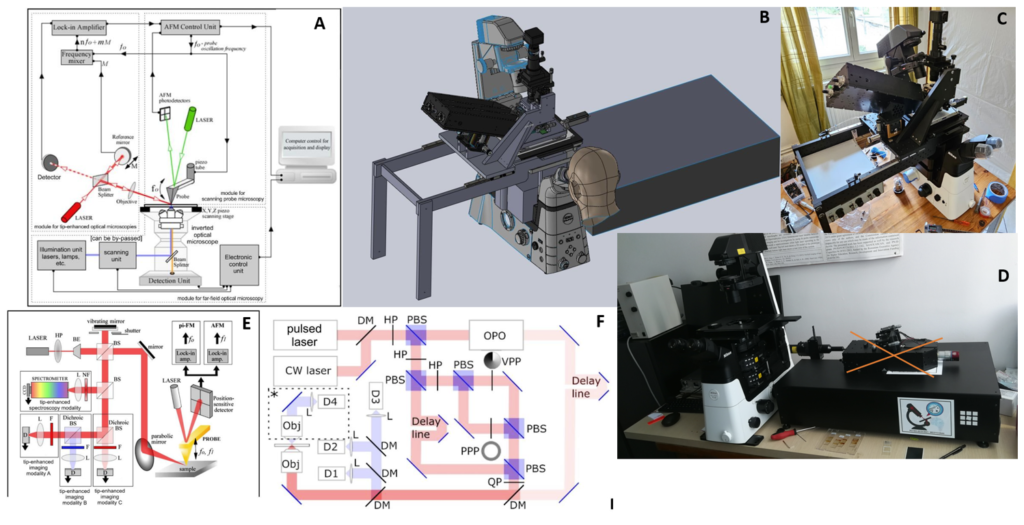
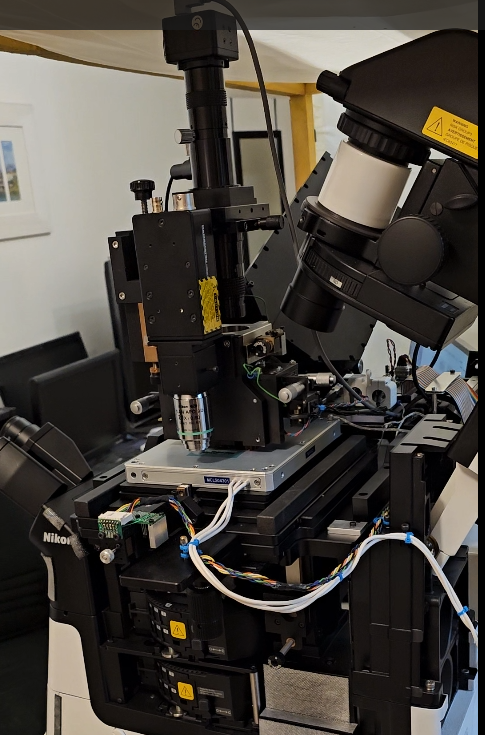
Schematic diagram (A) and 3D model (B) of the INTELINANO multimodal system under development at UPB, for correlative far-field/near-field/tip-enhanced microscopy/nanoscopy. By placing the sample on the stage of an inverted microscope, it can be probed from the top by a multimodal module for near-field/tip-enhanced microscopy, and from the bottom by a multimodal module for far-field nanoscopy . C) Photo of the multimodal module for near-field/tip-enhanced nanoscopy; D) Photo of the far-field module. E) Design concept of the imaging module for multimodal module for near-field/tip-enhanced microscopy. F) Design concept of the imaging module for multimodal far-field optical microscopies based on laser scanning
Public Summary of the Scientific & Technical Report of MEDYCONAI Grant Period 4 (1.01.2024-30.04.2024)
The MEDYCONAI project is dedicated to developing an advanced nanoscope called INTELINANO, which includes two specialized modules for optical nanoscopy in both the far-field and near-field regimes. INTELINANO aims to enable new capabilities for analyzing cells and advanced materials at the nanoscale by leveraging the unique and complementary functions of its operating modes. In the first phase (GP1), the design of these modules was completed. GP2 saw significant progress in their development, while GP3 further advanced their implementation, bringing the prototype closer to completion. The fourth phase (GP4) focused on optimizing the prototype’s modules to enhance speed, robustness, resolution, and signal-to-noise ratio. Additionally, the project team made advancements in cell imaging and the development of AI methods for microscopy. Specifically, in Work Package (WP) 2, the team optimized the transmission component of the far-field module to enable robust and reversible deployment on a plane above the sample, facilitating the collection of forward-traveling far-field signals. WP3 focused on deploying high-resolution imaging assays to explore critical, yet poorly understood, cellular processes related to membrane dynamics. For example, using fluorescence nanoscopy, the team studied double membrane vesicles, which are crucial for viral RNA replication and transcription in cells, revealing how hexameric structures connecting the vesicular lumen to the cytoplasm, named pores, form and traverse two membranes. In WP4, the teams advanced the development of artificial intelligence tools by designing new methods to simulate optical nanoscopy data, which is essential for creating synthetic training datasets and validation methods. These combined efforts in GP4 have resulted in the publication of three project supported articles in 2024, with three additional articles currently under peer review in journals with an impact factor > 10, and several others in preparation.